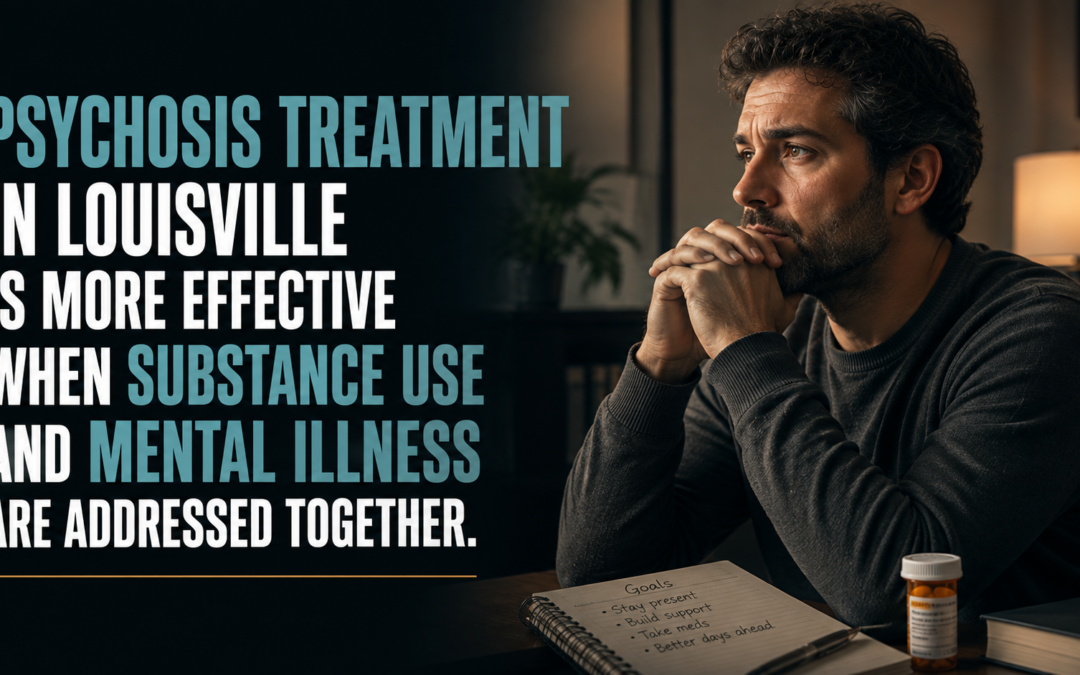
Psychosis treatment in Louisville works far better when substance use and mental illness are treated as one connected experience rather than two separate problems. When care addresses both at the same time, a person has a real chance at lasting stability instead of a cycle that keeps repeating.
If you or someone you love is facing psychosis alongside substance use, you are not alone, and this is not a hopeless situation. These two struggles often overlap, and understanding that connection changes everything about how healing happens.
The good news is that recovery is possible. With the right support, the confusion and fear that come with these experiences can ease, and steadier days can return.
What Is Psychosis Treatment in Louisville and Why Does the Dual Approach Matter?
Psychosis treatment in Louisville is specialized care that helps a person manage symptoms like hallucinations, delusions, or disorganized thinking, while also addressing any substance use present alongside them. The dual approach matters because these two conditions rarely exist in isolation.
Psychosis means a person has lost some connection to reality, often through experiences that feel completely real to them but are not shared by others. Substance use can trigger these episodes, worsen them, or develop as a way to cope with them.
Think of it like two threads tangled together. Pulling on just one rarely loosens the knot. Treating both at once is what finally allows real progress.
Why Does Treating Only One Condition Fall Short?
Treating only one condition falls short because the untreated struggle keeps pulling a person back down. Progress in one area often unravels when the other is left unaddressed.
Imagine repairing one wall of a house while leaving another to crumble. The whole structure stays unstable no matter how much effort goes into that single wall.
This is why integrated care has become the trusted standard. When both conditions receive attention together, healing has room to hold.
How Do Psychosis and Substance Use Interact?
Psychosis and substance use interact in a cycle where each one can intensify the other, making both harder to manage alone. This connection is common and well understood by clinical teams.
Some substances can trigger psychotic episodes directly, especially stimulants and certain drugs. For others, substance use begins as an attempt to quiet frightening or confusing experiences.
How Can Substances Trigger or Worsen Psychosis?
Substances can trigger or worsen psychosis by disrupting the brain chemistry that helps a person stay grounded in reality. Certain drugs overstimulate the systems that regulate perception and thought.
For someone already vulnerable to psychosis, substance use can spark an episode or deepen one that has already begun. Symptoms like paranoia, hallucinations, or racing thoughts may grow more intense.
These effects are not a reflection of a person’s character. They are signs that the brain is under real strain and needs care.
Why Do People Turn to Substances During Psychosis?
People turn to substances during psychosis because the experiences can be frightening, and drugs or alcohol may seem to offer temporary relief. Quieting the noise, even briefly, can feel like the only option.
This relief rarely lasts. Substances often heighten symptoms once they wear off, disrupt sleep, and make it harder to tell what is real.
The cycle then tightens. More distress leads to more use, and more use leads to more distress, which is exactly why breaking that loop requires support that treats both sides at once.
What Warning Signs Should Families Watch For?
Families should watch for a pattern of changes in thinking, behavior, and substance use rather than a single dramatic moment. Psychosis connected to substance use often builds gradually, so the overall pattern matters most.
You do not need proof of a crisis to start a caring conversation. Noticing a shift is reason enough to pay closer attention.
Common warning signs worth noticing include:
- Expressing unusual beliefs, suspicions, or fears that seem out of character
- Hearing, seeing, or sensing things that others do not
- Withdrawing from family, friends, or activities they once enjoyed
- Increasing use of alcohol or drugs, especially to cope with distress
- Confused speech, scattered thinking, or trouble following conversations
Noticing one sign now and then is part of life. Noticing several together, especially over weeks, is a strong signal to reach out for guidance.
How Is This Different From Ordinary Stress?
The difference is that these symptoms persist, deepen, and start interfering with daily life. Ordinary stress usually eases as circumstances settle.
Psychosis connected to substance use tends to grow rather than fade. When unusual thoughts, withdrawal, or substance use keep building over time, that is more than a rough patch.
Trusting your instinct matters here. If the changes feel lasting and worrying, a caring conversation and a professional assessment can bring clarity and peace of mind.
What Does Assessment and Integrated Treatment Involve?
Assessment involves a thoughtful conversation with a trained clinician about a person’s thoughts, moods, substance use, and daily experiences. Integrated treatment then combines mental health care and substance use support within one coordinated plan.
A good assessment takes time and care. It looks at the full picture, including history, current symptoms, and the support a person has around them.
What Happens During Treatment?
During treatment, a caring team helps a person understand their experiences, stabilize safely, and build practical tools for lasting change. Care is personalized, never one-size-fits-all.
Most integrated plans blend several proven approaches:
- Medication management, guided by a caring prescriber who monitors how a person feels and adjusts as needed
- Individual therapy to explore experiences, triggers, and coping skills
- Cognitive Behavioral Therapy, which helps a person gently examine and reshape distressing thought patterns
- Substance use support that addresses cravings, triggers, and healthier ways to cope
- Family education so loved ones understand what is happening and can offer steady, informed help
Each piece works toward the same goal. The aim is to help a person feel safer, clearer, and more in control of their own life.
How Does Integrated Care Address the Whole Person?
Integrated care addresses the whole person by treating mental health and substance use as connected rather than separate. Your team shares information and adjusts your plan as you grow.
Our mental health treatment programs are built around this idea. Rather than sending a person to one place for psychosis and another for substance use, care stays coordinated under one roof.
That coordination reduces confusion and helps a person feel understood as a full human being, not a list of symptoms.
What Levels of Care Are Available Near Louisville?
Levels of care range from around-the-clock support to flexible outpatient options, depending on how much structure a person needs right now. The right choice depends on current symptoms and safety.
At the Robert Alexander Center for Recovery, located a short drive from Louisville in Mount Washington, options include residential inpatient treatment for those who need a safe, immersive environment with continuous support, along with partial hospitalization and outpatient services for people building skills alongside daily life.
As stability grows, care can shift with the person. Support is meant to meet each individual exactly where they are.
How Do You Decide When to Seek Help?
You decide to seek help when changes in thinking, mood, or substance use feel persistent, frightening, or hard to manage on your own. You never have to wait for a crisis to deserve care.
Consider reaching out if any of these feel true:
- Unusual thoughts, perceptions, or fears are becoming more frequent or intense
- Substance use has increased, especially alongside confusing or distressing experiences
- You or a loved one has withdrawn from people, activities, or responsibilities
- Sleep, focus, or daily functioning has become difficult to maintain
- A loved one has expressed worry about safety, thinking, or substance use
If any of these resonate, that is reason enough to start a conversation with a caring professional. An honest assessment can help you understand what is happening and which kind of support fits best.
Common Questions Families Often Ask
Can substance use really cause psychosis?
Yes. Some substances can trigger psychotic episodes, and others can worsen symptoms in a person already vulnerable to them. A careful assessment helps sort out what is driving the experiences and what kind of care fits.
Should we treat the substance use or the psychosis first?
Both, at the same time. Integrated treatment addresses mental health and substance use together, because progress in one area supports progress in the other.
Can someone recover from both conditions?
Yes. Many people find real stability when both conditions receive care within one coordinated plan. Recovery is a journey, and the right support makes it far more achievable.
How soon can care begin?
Support can start soon after you reach out. Our admissions team is available to answer your questions, verify insurance, and guide you toward the next step with patience and care.
You Do Not Have to Face This Alone
Psychosis treatment in Louisville is most effective when substance use and mental illness are addressed together, because caring for the whole person is what allows healing to truly hold. Treating these struggles as connected means a person no longer has to feel torn between two battles or worry that one will be left behind.
Recovery is possible, and reaching out is a brave, hopeful step. With integrated support and compassionate care, the fear and confusion can ease, and steadier days can return.
If you or someone you love is struggling with psychosis alongside substance use, please reach out to the Robert Alexander Center for Recovery today. Our caring team is ready to listen, answer your questions, and help you take the next step toward steadier, more hopeful days ahead. You are not alone, and help is here whenever you are ready.