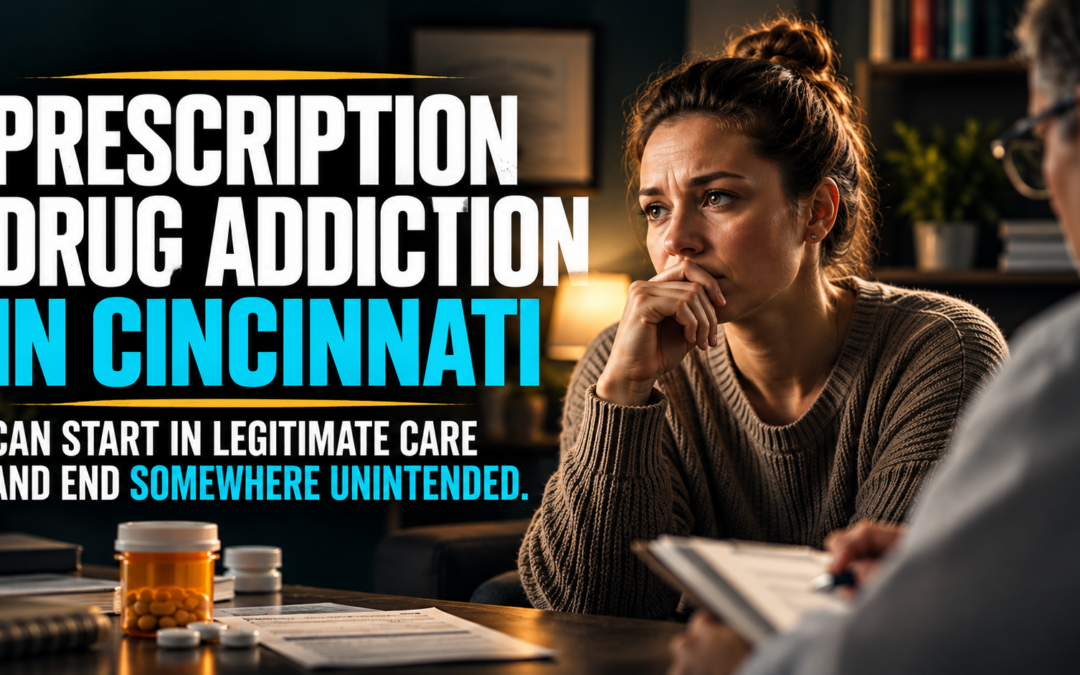
Prescription drug addiction in Cincinnati often begins in a doctor’s office, not on a street corner. A back surgery, a car accident, a season of panic attacks or a demanding semester leads to a prescription that genuinely helps. Months later, that same medication can feel impossible to put down.
If this is your story, or the story of someone you love, please know you did nothing shameful. You followed medical advice, trusted a provider and took a medication meant to ease real pain. Your body adapted in ways no one fully explained to you.
This kind of dependence is treatable. Many people move through it with medical support, honest guidance and a plan built around their needs. Understanding how the shift happened can be the first step toward feeling steady again.
How Does Prescription Drug Addiction in Cincinnati Begin in Legitimate Care?
Prescription drug addiction in Cincinnati usually begins when a medication prescribed for a real medical need slowly changes how the brain and body work. The prescription is legitimate. The dependence that follows is an effect of the drug, not a failure of character.
The medications most often involved include:
- Opioid pain relievers such as oxycodone and hydrocodone, often prescribed after injuries or surgery
- Benzodiazepines such as Xanax and Klonopin, prescribed for anxiety, panic or sleep
- Stimulants such as Adderall, prescribed for attention-deficit/hyperactivity disorder (ADHD)
- Sleep medications such as zolpidem (Ambien), prescribed for insomnia
Each of these helps many people safely. Each can also lead to dependence when it is used over weeks or months.
What Happens in the Body Over Time?
Over time, the body builds tolerance, which means the same dose produces less effect. A person may notice pain returning sooner or anxiety creeping back before the next pill is due.
Think of it like a thermostat that slowly resets. The body begins to treat the medication as its new normal. Without it, the system swings out of balance and withdrawal symptoms appear.
This is called physical dependence. It can develop even when someone takes a medication exactly as directed.
Why Do Some People Face Higher Risk?
Some people face higher risk because of factors they cannot always see, such as genetics, past trauma, chronic pain or a mental health condition. Long prescriptions, higher doses and stressful life events can also raise the risk.
Prescription drug addiction in Cincinnati can affect anyone, from retirees to college students to people in physically demanding trades. A person managing ongoing pain may stay on opioids far longer than first planned. Someone with untreated anxiety may come to rely on a benzodiazepine for every hard moment. Neither person set out to misuse anything.
Why Don’t Patients Recognize the Shift Into Dependence?
Patients often miss the shift because the medication came from a trusted source and still feels like treatment. Prescription drug addiction in Cincinnati rarely announces itself. It hides behind a pharmacy label with the patient’s own name on it.
Why Does a Prescription Feel So Safe?
A prescription feels safe because a medical professional chose it and a pharmacist filled it. Most people reasonably assume that following the directions removes the risk.
That trust makes sense. Yet the medication acts on the brain the same way, whether or not a person feels at risk.
How Does the Line Blur Between Need and Dependence?
The line blurs when a person starts taking the medication to avoid withdrawal rather than to treat the original problem. The injury may have healed, but stopping now brings aches, restlessness or panic.
Picture a crutch used after a broken ankle. At first, it helps you walk. If you keep leaning on it long after the bone heals, the leg weakens and letting go feels frightening.
Many people only notice the change when a prescription runs out early or a doctor begins lowering the dose. That moment can feel confusing and scary. It is also often the moment when real change becomes possible.
Where Does Prescription Drug Addiction in Cincinnati Lead When It Goes Unaddressed?
Prescription drug addiction in Cincinnati can lead people toward places they never intended, such as seeing multiple prescribers, borrowing pills or buying them from unknown sources. These steps usually come from fear of withdrawal, not a wish to cause harm.
Ohio tracks controlled substance prescriptions through a statewide system called the Ohio Automated Rx Reporting System (OARRS). Providers use it to spot overlapping prescriptions and limit early refills. For people living with prescription drug addiction in Cincinnati, a sudden gap in supply can feel terrifying.
Why Is This Shift So Dangerous?
This shift is dangerous because pills sold outside a pharmacy may be counterfeit and contain fentanyl, a powerful synthetic opioid. A counterfeit pill can look exactly like a real prescription and still carry a deadly dose.
This is not meant to frighten you. It is meant to show why reaching out early matters so much. Keeping naloxone (often sold as Narcan) at home is a simple safety step, and many Cincinnati pharmacies offer it without a prescription.
What Warning Signs Should Families Notice?
Families should look for a pattern of changes in medication use, mood and daily life rather than one isolated moment. Prescription drug addiction in Cincinnati often looks ordinary from the outside, so loved ones at home may see the clearest picture.
Signs worth paying attention to include:
- Running out of prescriptions early or asking for refills sooner than expected
- Visiting more than one doctor or pharmacy for the same medication
- Taking higher doses or using pills for new reasons, like stress or sleep
- Seeming anxious, irritable or unwell when a dose is late
- Defending the medication strongly whenever someone raises a concern
- Pills going missing from a family member’s medicine cabinet
- Pulling away from family, work or activities they once enjoyed
One sign may simply reflect a hard season. Several signs together over weeks deserve a caring conversation.
How Can You Start That Conversation?
You can start by choosing a calm, private moment and sharing what you have noticed with love rather than blame. Keep the focus on their health, not on accusations.
You might say, “I’ve noticed your refills seem to run out fast, and I’m worried about you.” Then listen. Offering to explore options together can make the next step feel far less lonely.
What Does Treatment for Prescription Drug Addiction in Cincinnati Include?
Treatment for prescription drug addiction in Cincinnati includes medical support, therapy and a plan that respects the reason the medication was first prescribed. Care is personalized, never one-size-fits-all.
A strong plan addresses both the dependence and the pain, anxiety or attention concerns underneath it. Removing a medication without replacing what it was doing rarely lasts.
Why Is Medical Detox Often the First Step?
Medical detox is often the first step because stopping certain prescriptions suddenly can be uncomfortable or even dangerous. Benzodiazepine withdrawal, for example, can cause seizures without a careful taper.
For many people facing prescription drug addiction in Cincinnati, medical detox offers a safe place to begin. Trained staff lower medication gradually, monitor vital signs and ease withdrawal symptoms. This creates a stable foundation for the work ahead.
What Happens After Detox?
After detox, ongoing treatment helps a person understand their patterns and build healthier ways to cope. Most plans blend several approaches:
- Individual therapy to explore triggers and build practical coping skills
- Cognitive Behavioral Therapy (CBT), which helps reshape thoughts like “I can’t get through the day without it”
- Medication support when appropriate, including medication-assisted treatment for opioid dependence
- Non-addictive pain and anxiety strategies coordinated with medical providers
- Family involvement to rebuild trust and communication at home
Many people also carry anxiety, depression or trauma beneath their medication use. Our mental health treatment programs care for these struggles side by side with substance use.
What Levels of Care Are Available Near Cincinnati?
Levels of care range from immersive residential support to flexible outpatient options, depending on safety, severity and support at home. The Robert Alexander Center for Recovery in Mount Washington, Kentucky, is within driving distance for many families across the greater Cincinnati area.
For people facing prescription drug addiction in Cincinnati who need distance from daily triggers, residential inpatient care provides support around the clock. Others may do well with outpatient care that fits around work and family. As progress grows, care can shift to match each person’s needs.
How Do You Know When It Is Time to Seek Help?
It is time to seek help for prescription drug addiction in Cincinnati when a prescribed medication feels harder to control than it should, or when stopping feels impossible. You do not need to wait for a crisis to deserve care.
Consider reaching out if any of these feel true:
- You take your medication more often or in higher doses than prescribed.
- You feel sick, anxious or restless when a dose is late.
- The original reason for the prescription has eased, but you still cannot stop.
- You have looked for pills from other doctors, friends or unknown sources.
- A loved one has gently shared concern about your medication use.
If any of these resonate, a confidential conversation with a caring professional can bring clarity. If someone is unresponsive or struggling to breathe, call 911 right away and give naloxone if you have it.
What Families Often Ask
Can someone become addicted even if they followed their doctor’s directions?
Yes. Dependence can develop with careful, prescribed use because the body adapts to the medication over time. This is common and nothing to feel ashamed of.
Is prescription drug addiction in Cincinnati treated differently from other substance use?
The core of care is similar, including detox, therapy and ongoing support. The difference is that a good plan also addresses the medical condition behind the original prescription.
Should my loved one just stop taking the medication?
No. Stopping suddenly can be uncomfortable or unsafe, especially with benzodiazepines or opioids. A medically supervised taper is the safest path forward.
What if they still have real pain or anxiety?
That concern matters, and treatment takes it seriously. A care team can help build non-addictive strategies so recovery does not mean living with untreated symptoms.
How soon can care begin?
Support can begin soon after you reach out. Our admissions team can answer your questions, verify insurance and guide you toward the next step with patience and care.
Recovery Can Begin Where the Prescription Left Off
Prescription drug addiction in Cincinnati starts in legitimate care and ends somewhere the patient did not intend, but it does not have to stay there. The way it began says nothing about your worth or your willpower.
Recovery is possible, and reaching out is a brave, hopeful step. With safe medical support and compassionate care, the hold of a medication can loosen and steadier days can return.
If you or someone you love is struggling with prescription medication, please reach out to the Robert Alexander Center for Recovery today. Our caring team is ready to listen, answer your questions and help you take the next step. You are not alone, and help is here whenever you are ready.