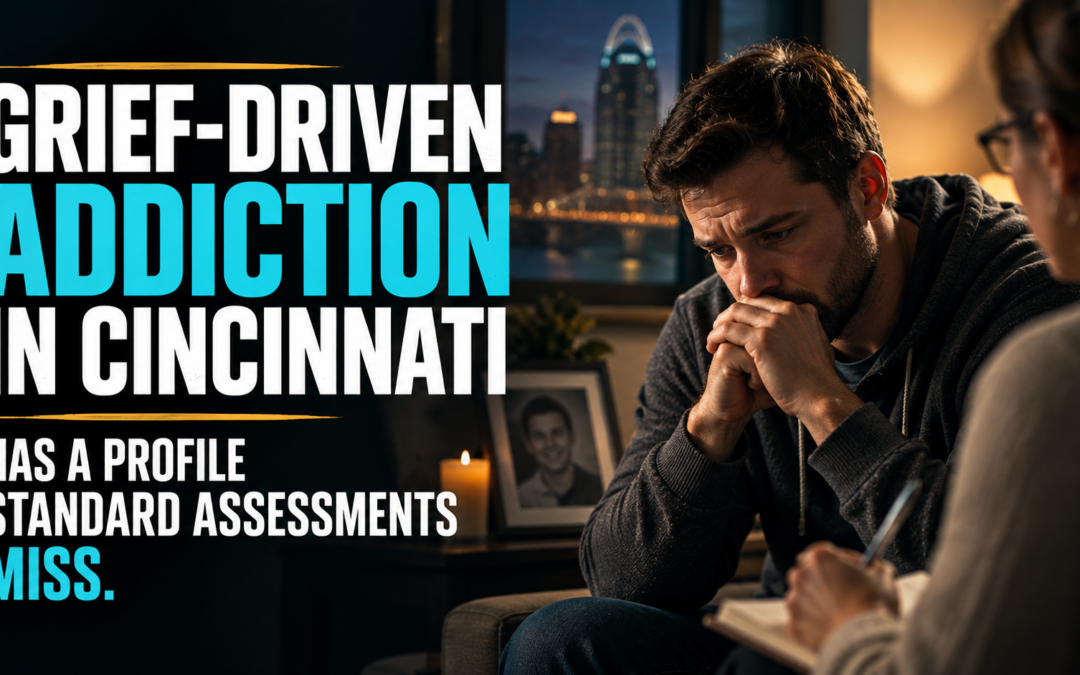
Grief-driven addiction in Cincinnati often goes unnoticed for months or even years, because it rarely looks like the substance use patterns most screening tools are built to find. A widow who drinks alone each evening may still keep a spotless home. A father who lost a son may still show up to work on time and use pills only at night.
If this sounds like you or someone you love, you are not failing and you are not weak. Loss changes the brain, the body and the way a person gets through the day. Reaching for relief after a devastating loss is a deeply human response.
The hopeful truth is that grief and substance use both respond to care. When a treatment team understands how the two connect, healing can reach the pain underneath and not only the drinking or drug use on the surface. You deserve care that sees the whole story.
What Is Grief-Driven Addiction in Cincinnati?
Grief-driven addiction in Cincinnati is a pattern of substance use that begins or worsens after a significant loss, where alcohol or drugs become the main way a person copes with sorrow. The loss is the engine, and the substance is the attempt to quiet it.
That loss may be a death, though it does not have to be. Divorce, miscarriage, a serious diagnosis, the loss of a career or estrangement from a child can all set the pattern in motion.
Think of grief as a heavy backpack a person never chose to carry. Substances can feel like they lighten the load for a few hours. In reality, they add weight while making it harder to notice how much is already there.
How Does It Present Differently From Other Substance Use Patterns?
Grief-driven substance use often presents as quiet, private and tied to specific emotional triggers rather than social settings or thrill-seeking. Many people use alone, at night or on dates connected to their loss.
Some had little history of heavy use before the loss. Others had a manageable relationship with alcohol that shifted sharply afterward.
Because the pattern looks so different from the stereotype of addiction, the person and their family may not recognize it. They may call it “getting through a hard time” long after it has become something more.
What Does the Grief-Driven Profile Usually Look Like?
The grief-driven profile usually combines a clear before-and-after timeline, solitary use and substance use that spikes around reminders of the loss. These features together set it apart.
Common elements of this profile include:
- A turning point, where use clearly increased after a specific loss
- Anniversary spikes, with heavier use around birthdays, holidays or the date of a death
- Nighttime use, often to fall asleep when sorrow feels loudest
- High daytime functioning, which hides the struggle from coworkers and friends
- Emotional numbness, where the person avoids talking about the loss at all
Recognizing this profile is the first step toward getting the right kind of help.
Why Do Standard Assessments Miss Grief-Driven Addiction in Cincinnati?
Standard assessments miss grief-driven addiction in Cincinnati because most screening tools measure how much and how often a person uses, not why the use began. The emotional driver can stay invisible even when the substance use is identified.
Screening tools play an important role. Still, a checklist cannot always capture a story of loss that a person may not feel ready to share.
What Do Standard Assessments Focus On?
Standard assessments focus mainly on quantity, frequency, withdrawal symptoms and consequences like legal or work problems. These questions help clinicians gauge severity and choose a safe level of care.
What they often leave out is timing and meaning. A tool may record that someone drinks six nights a week without asking what changed in their life when that began.
Without that question, grief can be mistaken for general stress or labeled as depression alone. The treatment plan then targets the symptoms while missing the source.
Why Does Grief Hide Behind Functional Behavior?
Grief hides behind functional behavior because many grieving people feel pressure to stay strong for their families, jobs or communities. Holding everything together in public can mean falling apart in private.
A person may answer screening questions honestly and still score in a lower-risk range. They are not using at work, they have no legal trouble and their bills are paid.
Meanwhile, they may be drinking every night just to sleep. This gap between appearance and reality is exactly why grief-driven addiction in Cincinnati so often goes undetected.
What Signs Should Families Notice?
Families should notice substance use that clearly increased after a loss and seems to rise and fall with painful reminders. You do not need certainty to start a caring conversation.
Signs worth paying attention to include:
- Drinking or using drugs more since the loss than they did before
- Heavier use around anniversaries, holidays or the deceased person’s birthday
- Refusing to talk about the loss, or changing the subject quickly
- Using substances to fall asleep or to “take the edge off” each evening
- Pulling away from friends, faith communities or activities they once enjoyed
- Saying things like “I just need this to get through the day”
- Looking fine in public while seeming hollow or exhausted at home
One sign on its own may simply reflect a hard season. Several signs together deserve gentle attention.
How Is Healthy Mourning Different From Grief-Driven Use?
Healthy mourning usually softens over time, even though painful waves still return. Grief-driven use tends to freeze grief in place, because the substance blocks the emotions a person needs to work through.
Crying, anger and longing are a natural part of loss. They are signs that a person is processing what happened.
When alcohol or drugs become the main way to avoid those feelings, healing stalls. The grief often stays raw, sometimes for years.
What Does Integrated Treatment Include?
Integrated treatment includes care for both the loss and the substance use within one plan, guided by one coordinated team. Neither struggle is set aside or treated as an afterthought.
Our mental health treatment programs are designed to address emotional pain and substance use side by side. When one team sees the full picture, the plan can target what is actually driving the use.
Most integrated plans blend several approaches:
- Individual therapy to explore the loss and build healthy ways to cope with sorrow
- Cognitive Behavioral Therapy (CBT), which helps a person notice and reshape thought patterns that fuel both grief and substance use
- Grief-focused work that creates space to honor what or who was lost
- Group therapy that connects people who understand loss and recovery firsthand
- Medication support when appropriate, guided by a caring prescriber
- Family involvement, so loved ones can heal and grieve together
What Should a Grief-Informed Assessment Ask?
A grief-informed assessment should ask when substance use changed and what was happening in a person’s life at that time. That single question can reshape an entire treatment plan.
Clinicians may also ask about anniversaries, sleep, isolation and whether the person has had space to mourn. These questions are asked gently and at a pace that feels safe.
When grief is named early, treatment can address it from the start rather than discovering it after a relapse.
What Levels of Care Are Available Near Cincinnati?
Levels of care range from immersive residential support to flexible outpatient options, depending on safety, severity of use and support at home. The right fit depends on each person’s needs right now.
For people who need structure and distance from daily reminders of their loss, residential inpatient care offers steady support around the clock. Many families from the greater Cincinnati area choose this setting for focused healing.
Others may do well with outpatient care that fits around work and family life. As a person grows steadier, care can shift with them.
How Do You Know When It Is Time to Seek Help?
It is time to seek help when substance use and grief feel tangled together in ways that are hard to manage alone. You never have to wait for a crisis to deserve support.
Consider reaching out if any of these feel true:
- You or your loved one started drinking or using drugs more after a loss.
- Painful reminders of the loss often lead to heavier substance use.
- A past screening or counseling experience never asked about the loss.
- Grief feels frozen and has not softened with time.
- Health, sleep or relationships are slipping because of both struggles.
- Someone close to you has gently shared concern about your mood or your use.
If any of these resonate, an honest conversation with a caring professional can bring clarity. If you or someone you love is having thoughts of suicide, please call or text 988 or call 911 right away.
What Families Often Ask
Why didn’t an earlier assessment catch the grief?
Many screening tools focus on how much and how often a person uses, not why the pattern started. A grief-informed assessment asks about timing and loss, which helps reveal what standard tools can miss.
Is it normal to use substances after losing someone?
Many people reach for relief during grief, and that response is understandable. When substances become the main way of coping, though, they can block healing and lead to dependence.
Should grief or substance use be treated first?
Both should be treated together. Integrated care addresses grief and substance use at the same time, because progress in one supports progress in the other.
How soon can care begin?
Support can begin soon after you reach out. Our admissions team can answer your questions, verify insurance and guide you toward the next step with patience and care.
You Do Not Have to Carry This Loss Alone
Grief-driven addiction in Cincinnati has a profile that standard assessments are not designed to catch, which is why naming the loss matters so much. When care reaches the grief beneath the substance use, real healing has room to begin.
Recovery is possible, and reaching out is a brave, hopeful step. With compassionate support built for the whole person, sorrow can slowly soften and steadier days can return.
If you or someone you love is grieving while struggling with substance use, please reach out to the Robert Alexander Center for Recovery today. Our caring team is ready to listen, answer your questions and help you take the next step forward. You are not alone, and help is here whenever you are ready.